Generic AI vs Agentic AI: Understanding the Evolution of Artificial Intelligence

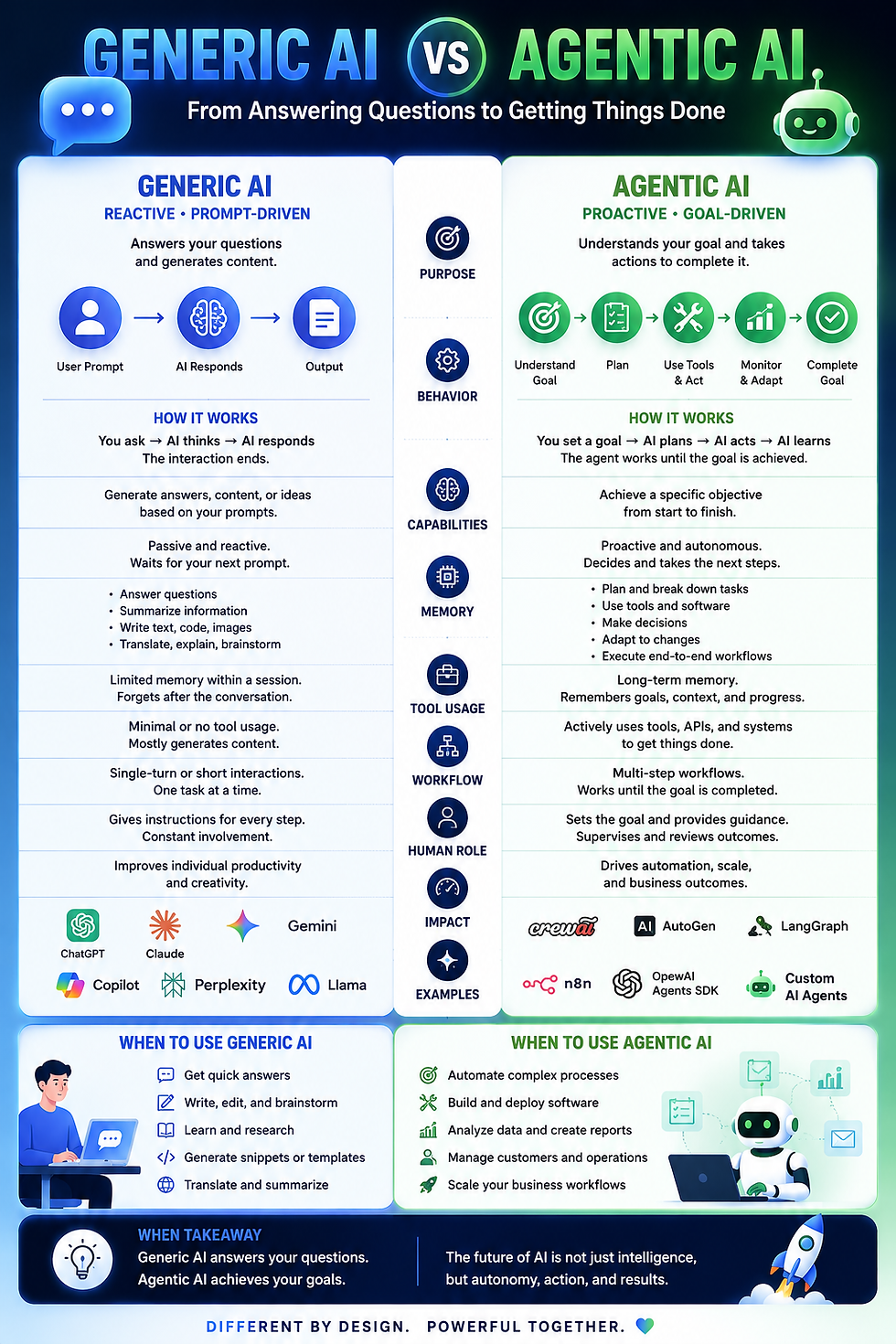
Artificial Intelligence (AI) has rapidly evolved over the past decade. While many people are familiar with AI tools such as ChatGPT, Claude, Gemini, and image generators, a new generation of AI systems is emerging—Agentic AI.
Although both Generic AI and Agentic AI leverage powerful large language models (LLMs), they are designed for fundamentally different purposes. Understanding the distinction is essential for businesses, developers, and professionals seeking to adopt AI effectively.
What is Generic AI?
Generic AI refers to AI systems that primarily respond to user prompts. They are reactive rather than proactive.
The workflow is simple:
User asks → AI generates response → Conversation ends
These systems excel at generating content, answering questions, translating languages, summarizing documents, writing code, brainstorming ideas, and explaining concepts.
They do not independently pursue goals or execute actions beyond generating outputs.
Examples of Generic AI
ChatGPT
Claude
Google Gemini
Microsoft Copilot
Perplexity AI
DeepSeek
Mistral AI
Meta AI
These tools become active only when the user provides instructions.
Characteristics of Generic AI
Generic AI typically has the following traits:
Prompt-driven
Reactive
Generates text, images, code, or audio
Limited memory during a session
Minimal long-term planning
Cannot autonomously complete multi-step workflows
Usually requires human approval for every step
For example:
A user asks:
"Write a blog about IPO preparation."
The AI generates the article.
The task is complete.
If the user wants an infographic, social media post, or translation, they must issue additional prompts.
What is Agentic AI?
Agentic AI represents the next stage in AI evolution.
Instead of merely answering prompts, Agentic AI can:
Understand objectives
Create plans
Break goals into tasks
Use software tools
Gather information
Make decisions
Execute workflows
Adapt when circumstances change
Instead of waiting for every instruction, Agentic AI actively works toward completing a defined objective.
Rather than asking:
"What should I do next?"
An AI agent determines the next step itself.
Simple Analogy
Imagine building a website.
Generic AI
You ask:
Write homepage
Design logo
Write CSS
Create database schema
Write API
Deploy website
You provide every instruction manually.
Agentic AI
You simply say:
"Build me a website for an accounting consulting firm."
The AI agent may automatically:
Gather requirements
Create project structure
Design UI
Build frontend
Build backend
Create database
Configure authentication
Test functionality
Deploy the application
Report progress
Fix detected errors
The user mainly supervises instead of directing every individual task.
Core Differences
Feature | Generic AI | Agentic AI |
Interaction | Prompt-response | Goal-driven |
Initiative | Passive | Proactive |
Planning | None | Multi-step planning |
Memory | Limited | Persistent task memory |
Tool Usage | Usually manual | Autonomous |
Decision Making | Minimal | Dynamic |
Workflow Execution | Single task | End-to-end automation |
Adaptability | Low | High |
Human Supervision | Constant | Occasional |
How Agentic AI Works
An Agentic AI system generally follows this cycle:
Step 1 — Receive Objective
Example:
"Launch my company website."
Step 2 — Understand the Goal
The AI analyzes:
Business type
Target audience
Required features
Budget
Timeline
Step 3 — Create a Plan
The AI automatically generates a roadmap.
Example:
Gather requirements
Design UI
Build frontend
Build backend
Create database
Connect APIs
Deploy
Test
Optimize SEO
Step 4 — Execute Tasks
Instead of writing everything itself, the AI uses tools.
Examples include:
GitHub
Supabase
PostgreSQL
Docker
Figma
Cloud hosting
APIs
Payment gateways
Step 5 — Evaluate Results
The AI verifies whether tasks succeeded.
If deployment fails, it identifies the issue and attempts another solution.
Step 6 — Continue Until Goal is Completed
Unlike Generic AI, Agentic AI continues working until the objective has been achieved or it encounters a blocker that requires human input.
The Building Blocks of Agentic AI
Most AI agents consist of several interconnected components.
1. Large Language Model (LLM)
The reasoning engine.
Examples include:
GPT
Claude
Gemini
Llama
2. Memory
Allows the agent to remember:
Previous conversations
Project status
User preferences
Completed tasks
3. Planning Engine
Breaks complex objectives into manageable subtasks.
4. Tool Calling
Enables interaction with external software.
Examples:
GitHub
Google Calendar
Gmail
Slack
Databases
Web browsers
CRMs
5. Reasoning Loop
A continuous cycle:
Think
↓
Plan
↓
Act
↓
Observe
↓
Reflect
↓
Improve
↓
Repeat
6. Feedback System
The agent checks whether outputs meet the intended goal and refines them when necessary.
Real-World Examples
Software Development
Generic AI:
Writes a Python function.
Agentic AI:
Builds an entire software application.
Accounting
Generic AI:
Explains IFRS 16.
Agentic AI:
Reads accounting data
Classifies leases
Calculates lease liabilities
Generates journal entries
Produces financial statements
Flags exceptions for review
Marketing
Generic AI:
Writes one LinkedIn post.
Agentic AI:
Creates a full campaign by:
Researching competitors
Writing blogs
Designing graphics
Scheduling social media
Tracking analytics
Recommending improvements
Customer Service
Generic AI:
Answers one customer question.
Agentic AI:
Reads customer history
Checks order status
Initiates refunds
Updates CRM
Escalates complex cases
Sends follow-up emails
Technologies Enabling Agentic AI
Several modern technologies have accelerated the development of AI agents.
Large Language Models
Provide reasoning and language understanding.
Examples:
GPT
Claude
Gemini
Llama
Retrieval-Augmented Generation (RAG)
Allows AI to retrieve accurate information from:
Company documents
Knowledge bases
Databases
Internal systems
APIs
Agents interact with external services such as:
Stripe
GitHub
Slack
Salesforce
Notion
Jira
Vector Databases
Support long-term semantic memory.
Popular choices include:
Pinecone
Weaviate
Chroma
Milvus
Workflow Engines
Coordinate complex multi-step automation.
Examples include:
n8n
LangGraph
CrewAI
AutoGen
Benefits of Agentic AI
Organizations adopting Agentic AI can gain:
Increased Productivity
Routine work becomes automated.
Faster Decision Making
Agents gather and analyze information before presenting recommendations.
Reduced Human Error
Automated validation helps identify mistakes before they affect business operations.
Continuous Operation
AI agents can work around the clock without fatigue.
Scalability
One AI agent can manage workloads that previously required multiple employees.
Challenges
Despite its advantages, Agentic AI introduces new considerations.
Reliability
Poor planning can lead to incorrect outcomes.
Security
Agents often require access to sensitive systems and must be governed carefully.
Cost
Running multiple autonomous agents may increase infrastructure expenses.
Governance
Organizations need clear policies defining:
Agent permissions
Human approvals
Audit logs
Compliance controls
When Should You Use Generic AI?
Generic AI is ideal for:
Writing content
Learning new topics
Brainstorming ideas
Translation
Code snippets
Quick research
Daily productivity
When Should You Use Agentic AI?
Agentic AI is better suited for:
Building applications
Financial analysis
Business process automation
Software engineering
Customer support
Research automation
Data processing
Sales workflows
Marketing campaigns
Enterprise operations
The Future of AI
The future of artificial intelligence is moving beyond simple chatbots toward intelligent digital coworkers.
Instead of answering isolated questions, AI systems are increasingly capable of planning projects, coordinating tools, collaborating with humans, and executing complex workflows with minimal supervision.
As reasoning models, memory systems, and software integrations continue to improve, Agentic AI is expected to become a foundational technology across industries such as finance, healthcare, logistics, manufacturing, education, and software development.
Final Thoughts
Generic AI and Agentic AI are not competing technologies—they are complementary.
Generic AI excels at generating information, ideas, and content in response to prompts. It acts as a knowledgeable assistant that enhances individual productivity.
Agentic AI extends these capabilities by adding planning, memory, decision-making, and autonomous execution. Rather than simply answering questions, it can complete sophisticated tasks, orchestrate workflows, and collaborate with multiple software tools to achieve broader objectives.
For individuals, Generic AI remains an invaluable daily assistant. For organizations seeking end-to-end automation and digital transformation, Agentic AI represents the next frontier of intelligent systems. As AI continues to evolve, understanding when to use each approach will be key to unlocking their full potential.
---
Comparison of Real-World AI Tools: Generic AI vs Agentic AI
Tool | Category | AI Type | Primary Purpose | Autonomous? | Multi-Step Planning | Tool Integration | Best Use Cases | Technical Skill Required |
ChatGPT | AI Assistant | Generic AI | Conversational AI, writing, coding, research | ❌ No | ❌ Limited | ✅ Plugins, APIs, MCP, connectors | Writing, brainstorming, coding, learning | Beginner |
Claude | AI Assistant | Generic AI | Long-document analysis, writing, coding | ❌ No | ❌ Limited | ✅ APIs, MCP | Documentation, legal review, analysis | Beginner |
Google Gemini | AI Assistant | Generic AI | Productivity and multimodal AI | ❌ No | ❌ Limited | ✅ Google Workspace | Email, Docs, Search, coding | Beginner |
Microsoft Copilot | Productivity AI | Generic AI | Office productivity | ❌ No | ❌ Limited | ✅ Microsoft 365 | Excel, Word, Outlook, Teams | Beginner |
GitHub Copilot | Coding Assistant | Generic AI | AI pair programmer | ❌ No | ⚠️ Limited | ✅ GitHub, IDEs | Code generation, debugging | Beginner–Intermediate |
Cursor | AI IDE | Semi-Agentic | AI-powered software development | ✅ Yes | ✅ Yes | ✅ Terminal, Git, IDE | Full-stack development, refactoring | Intermediate |
Perplexity AI | AI Search | Generic AI | AI-powered search engine | ❌ No | ❌ No | ✅ Web Search | Research and citations | Beginner |
NotebookLM | Research Assistant | Generic AI | Knowledge synthesis | ❌ No | ❌ No | ✅ Google Docs, PDFs | Studying and document analysis | Beginner |
OpenAI Agents SDK | Agent Framework | Agentic AI | Build autonomous AI agents | ✅ Yes | ✅ Excellent | ✅ Extensive APIs & tools | Custom AI applications | Advanced |
LangGraph | Agent Framework | Agentic AI | Stateful AI workflows | ✅ Yes | ✅ Excellent | ✅ Any API or LLM | Enterprise AI agents | Advanced |
CrewAI | Multi-Agent Framework | Agentic AI | Teams of AI agents | ✅ Yes | ✅ Excellent | ✅ Any tool | Multi-agent collaboration | Intermediate–Advanced |
AutoGen | Multi-Agent Framework | Agentic AI | Autonomous agent conversations | ✅ Yes | ✅ Excellent | ✅ Python ecosystem | AI collaboration and automation | Advanced |
n8n | Workflow Automation | Agentic AI | No-code AI automation | ✅ Yes | ✅ Good | ✅ 500+ integrations | Business process automation | Beginner–Intermediate |
Zapier AI | Workflow Automation | Agentic AI | AI-enhanced business automation | ✅ Yes | ⚠️ Moderate | ✅ 8,000+ apps | Office and SaaS automation | Beginner |
LangChain | LLM Framework | Agentic AI | Build LLM applications | ✅ Yes | ✅ Excellent | ✅ Extensive | AI applications and RAG | Advanced |
Feature Comparison
Capability | ChatGPT | Claude | GitHub Copilot | Cursor | n8n | CrewAI | LangGraph | OpenAI Agents SDK |
Answer Questions | ✅ | ✅ | ⚠️ | ✅ | ❌ | ✅ | ✅ | ✅ |
Write Content | ✅ | ✅ | ⚠️ | ⚠️ | ❌ | ✅ | ✅ | ✅ |
Generate Code | ✅ | ✅ | ✅ | ⭐ Excellent | ❌ | ✅ | ✅ | ✅ |
Execute Code | ⚠️ Limited | ❌ | ❌ | ✅ | ✅ | ✅ | ✅ | ✅ |
Use External APIs | ✅ | ✅ | ⚠️ | ✅ | ⭐ Excellent | ⭐ Excellent | ⭐ Excellent | ⭐ Excellent |
Long-Term Memory | ⚠️ Limited | ⚠️ Limited | ❌ | ✅ | ✅ | ✅ | ✅ | ✅ |
Multi-Step Planning | ⚠️ | ⚠️ | ❌ | ✅ | ✅ | ⭐ Excellent | ⭐ Excellent | ⭐ Excellent |
Autonomous Decisions | ❌ | ❌ | ❌ | ✅ | ✅ | ⭐ Excellent | ⭐ Excellent | ⭐ Excellent |
Workflow Automation | ❌ | ❌ | ❌ | ⚠️ | ⭐ Excellent | ⭐ Excellent | ⭐ Excellent | ⭐ Excellent |
Multi-Agent Collaboration | ❌ | ❌ | ❌ | ❌ | ⚠️ | ⭐ Excellent | ⭐ Excellent | ⭐ Excellent |
Legend:
⭐ Excellent
✅ Supported
⚠️ Limited
❌ Not supported
Which Tool Should You Choose?
Goal | Recommended Tool(s) | Why |
Writing blogs, emails, reports | ChatGPT, Claude | Best natural language generation |
Research with citations | Perplexity AI, ChatGPT | Strong search and summarization |
Learn programming | ChatGPT, Claude | Excellent explanations and examples |
Daily coding assistance | GitHub Copilot | Seamless IDE integration |
Full-stack application development | Cursor | Can plan, code, debug, and refactor across an entire project |
Build AI-powered workflows | n8n | Visual workflow builder with AI integrations |
Automate business processes | n8n, Zapier AI | Connect hundreds or thousands of business applications |
Build custom AI agents | OpenAI Agents SDK | Native framework for production-grade AI agents |
Enterprise AI orchestration | LangGraph | Robust state management and complex workflow control |
Multi-agent collaboration | CrewAI, AutoGen | Specialized AI agents working together on complex tasks |
Retrieval-Augmented Generation (RAG) | LangChain, LangGraph | Knowledge retrieval and contextual reasoning |
Technology Stack Comparison
Layer | Generic AI Stack | Agentic AI Stack |
User Interface | ChatGPT, Claude, Gemini | Custom application or AI agent |
LLM | GPT, Claude, Gemini | GPT, Claude, Gemini, Llama |
Memory | Conversation history | Persistent memory, vector databases |
Planning | User-driven | AI-driven planning engine |
Workflow | Single prompt | Multi-step execution |
Tools | Optional | Essential |
APIs | Limited | Extensive |
Databases | Optional | Frequently required |
Human Role | Ask every step | Define goals and supervise |
Typical Architecture
Generic AI | Agentic AI |
User → Prompt → LLM → Response | User → Goal → Planner → Memory → Tool Calling → Execution → Evaluation → Iteration → Final Result |
Summary
Generic AI | Agentic AI |
Answers questions | Achieves objectives |
Reacts to prompts | Proactively plans and acts |
Generates content | Executes end-to-end workflows |
Best for individuals | Best for teams and enterprises |
Human controls every step | Human defines goals and supervises |
Examples: ChatGPT, Claude, Gemini, GitHub Copilot | Examples: Cursor, n8n, LangGraph, CrewAI, OpenAI Agents SDK |
Key takeaway: Generic AI is ideal for creating knowledge and content on demand, while Agentic AI is designed to plan, coordinate tools, and autonomously execute complex tasks to achieve defined goals. Many modern AI solutions combine both approaches—for example, using an LLM like ChatGPT or Claude for reasoning within an agent framework such as OpenAI Agents SDK, LangGraph, or CrewAI.


Comments