Should You Choose to Establish a Private Company, Single-Member LLC, or Multi-Member LLC in Vietnam?

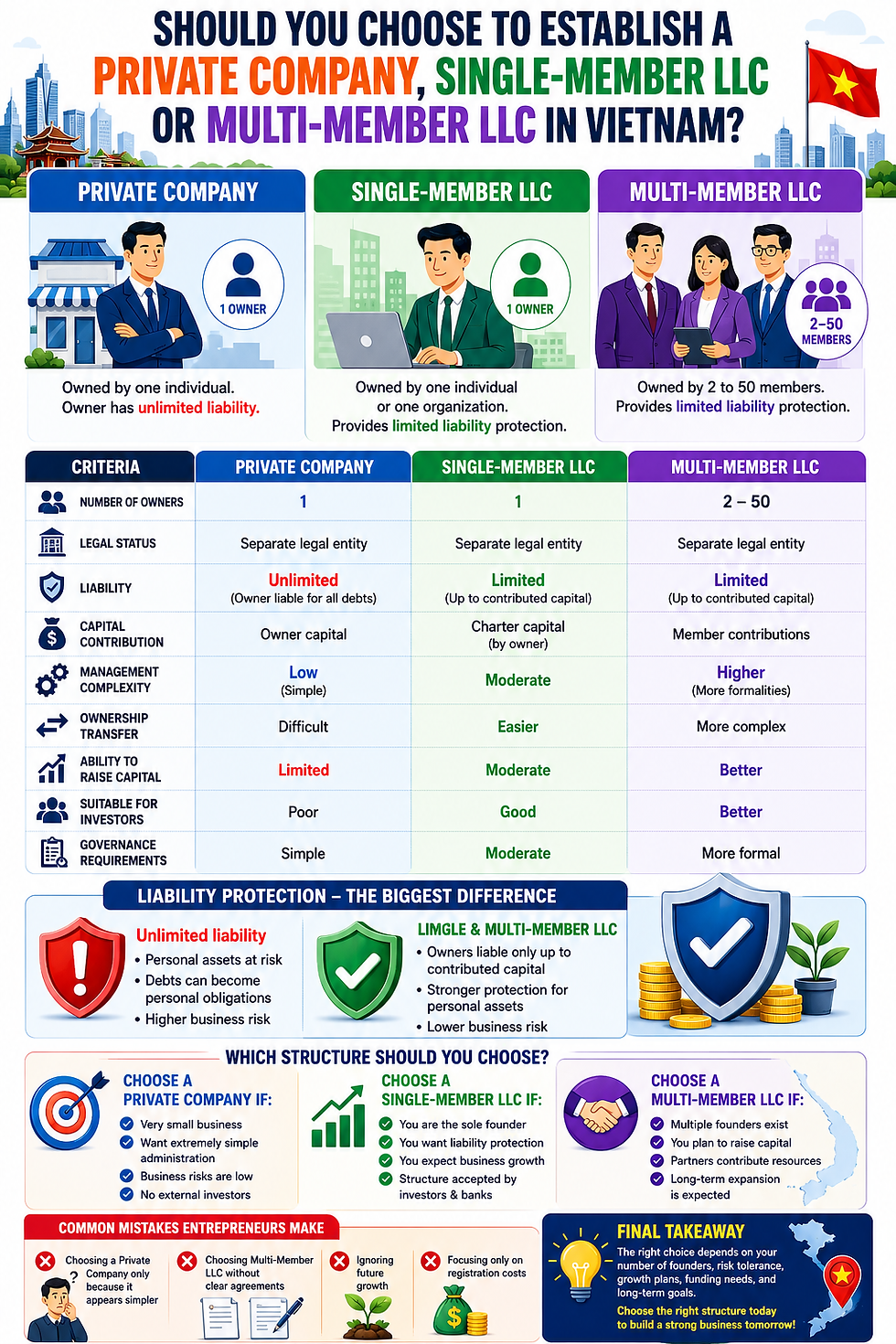
Should You Choose to Establish a Private Company, Single-Member LLC, or Multi-Member LLC in Vietnam?
Introduction
Starting a business in Vietnam begins with one critical decision: choosing the right legal structure.
Many entrepreneurs and investors ask the same question:
Should I establish a Private Company, a Single-Member LLC, or a Multi-Member LLC?
The answer depends on ownership structure, liability concerns, capital raising plans, operational flexibility, and long-term business objectives.
Vietnamese business law provides several company structures, but among the most commonly used are:
Private Company
Single-Member Limited Liability Company (Single-Member LLC)
Multi-Member Limited Liability Company (Multi-Member LLC)
Each structure offers different advantages and limitations. Choosing incorrectly may create unnecessary tax, management, and legal complications later.
This article explains the differences and helps determine which option may fit your business.
Understanding the Three Business Structures
1. Private Company
A Private Company is owned by one individual owner.
The owner:
Owns 100% of the business
Has complete decision-making authority
Bears unlimited liability for company obligations
Private companies are often chosen by small family businesses, retailers, or individual entrepreneurs who prefer simple operations.
Key Characteristics:
Only one owner allowed
Cannot issue equity shares
Unlimited liability
Simplified management
2. Single-Member LLC
A Single-Member LLC is a company owned by one individual or one organization.
Unlike a Private Company, this structure provides limited liability protection.
Key Characteristics:
One owner
Limited liability
Separate legal entity
Flexible management structure
This is one of the most common structures for startups and foreign-owned businesses.
3. Multi-Member LLC
A Multi-Member LLC allows multiple owners.
Vietnam generally permits:
Minimum: 2 members
Maximum: 50 members
This structure is suitable when multiple founders or investors participate.
Key Characteristics:
Multiple owners
Shared capital contributions
Limited liability
More formal governance requirements
Comparison Between Private Company, Single-Member LLC, and Multi-Member LLC
Criteria | Private Company | Single-Member LLC | Multi-Member LLC |
Number of Owners | 1 | 1 | 2–50 |
Legal Status | Separate entity | Separate entity | Separate entity |
Liability | Unlimited | Limited | Limited |
Capital Contribution | Owner capital | Charter capital | Member contributions |
Management Complexity | Low | Moderate | Higher |
Ownership Transfer | Difficult | Easier | More complex |
Ability to Raise Capital | Limited | Moderate | Better |
Suitable for Investors | Poor | Good | Better |
Governance Requirements | Simple | Moderate | More formal |
Liability Protection: One of the Biggest Differences
Private Company
The owner bears unlimited liability.
This means:
Personal assets may be exposed
Business debts can become personal obligations
Higher risk for growing businesses
Example:
If the company cannot repay debt, creditors may pursue personal assets.
Single-Member LLC and Multi-Member LLC
Both provide limited liability.
Generally:
Owners are liable only up to contributed capital
Personal assets receive stronger protection
Business risk becomes more manageable
For many entrepreneurs, this becomes the primary reason to choose LLC structures.
Capital Raising and Growth Potential
Private Company
Raising capital can be difficult because:
Ownership cannot easily expand
Investors may prefer structures with limited liability
Financing options become narrower
Single-Member LLC
Suitable for businesses with:
One founder
Moderate growth plans
Future restructuring possibilities
However, adding investors may require ownership restructuring.
Multi-Member LLC
Generally offers better fundraising opportunities because:
Multiple investors may contribute capital
Ownership percentages can be allocated
Expansion becomes easier
This structure is commonly selected for partnerships and startups.
Management Structure and Decision Making
Private Company
Advantages:
Fast decisions
Full control
Minimal internal procedures
Disadvantages:
Full responsibility remains with owner
Single-Member LLC
Still maintains centralized decision-making while benefiting from corporate protection.
Owners may establish:
Company President model
Owner-appointed management
Multi-Member LLC
Requires more formal governance.
Common components include:
Members’ Council
Voting procedures
Internal resolutions
Profit-sharing arrangements
Decision-making may become slower but benefits from shared expertise.
Which Structure Is Best for Different Types of Businesses?
Choose a Private Company If:
✓ You operate a very small business
✓ You want extremely simple administration
✓ Business risks remain relatively low
✓ You do not expect external investors
Choose a Single-Member LLC If:
✓ You are the sole founder
✓ You want liability protection
✓ You expect business growth
✓ You want a structure commonly accepted by investors and banks
Choose a Multi-Member LLC If:
✓ Multiple founders exist
✓ You plan to raise capital
✓ Partners contribute resources
✓ Long-term expansion is expected
Common Mistakes Entrepreneurs Make
Choosing a Private Company Only Because It Appears Simpler
Many founders underestimate liability exposure.
Choosing Multi-Member LLC Without Clear Agreements
Poor ownership arrangements create future conflicts.
Ignoring Future Growth
A structure that works today may become restrictive later.
Focusing Only on Registration Costs
Formation cost differences are often insignificant compared to long-term implications.
Final Thoughts
There is no universally “best” structure.
The right choice depends on:
Number of founders
Risk tolerance
Growth objectives
Funding plans
Operational complexity
For many modern businesses, Single-Member LLCs and Multi-Member LLCs provide stronger flexibility and protection than Private Companies.
However, entrepreneurs should evaluate both short-term needs and long-term expansion before making the final decision.
Choosing the correct structure from the beginning can save significant legal, operational, and financial costs in the future.
Source: internet


Comments