Three Lines of Defense on Risk Management in a Corporation

Introduction
Risk management has become one of the most critical components of corporate governance in modern organizations. Businesses face increasing operational, financial, regulatory, cybersecurity, and strategic risks that require structured oversight and accountability.
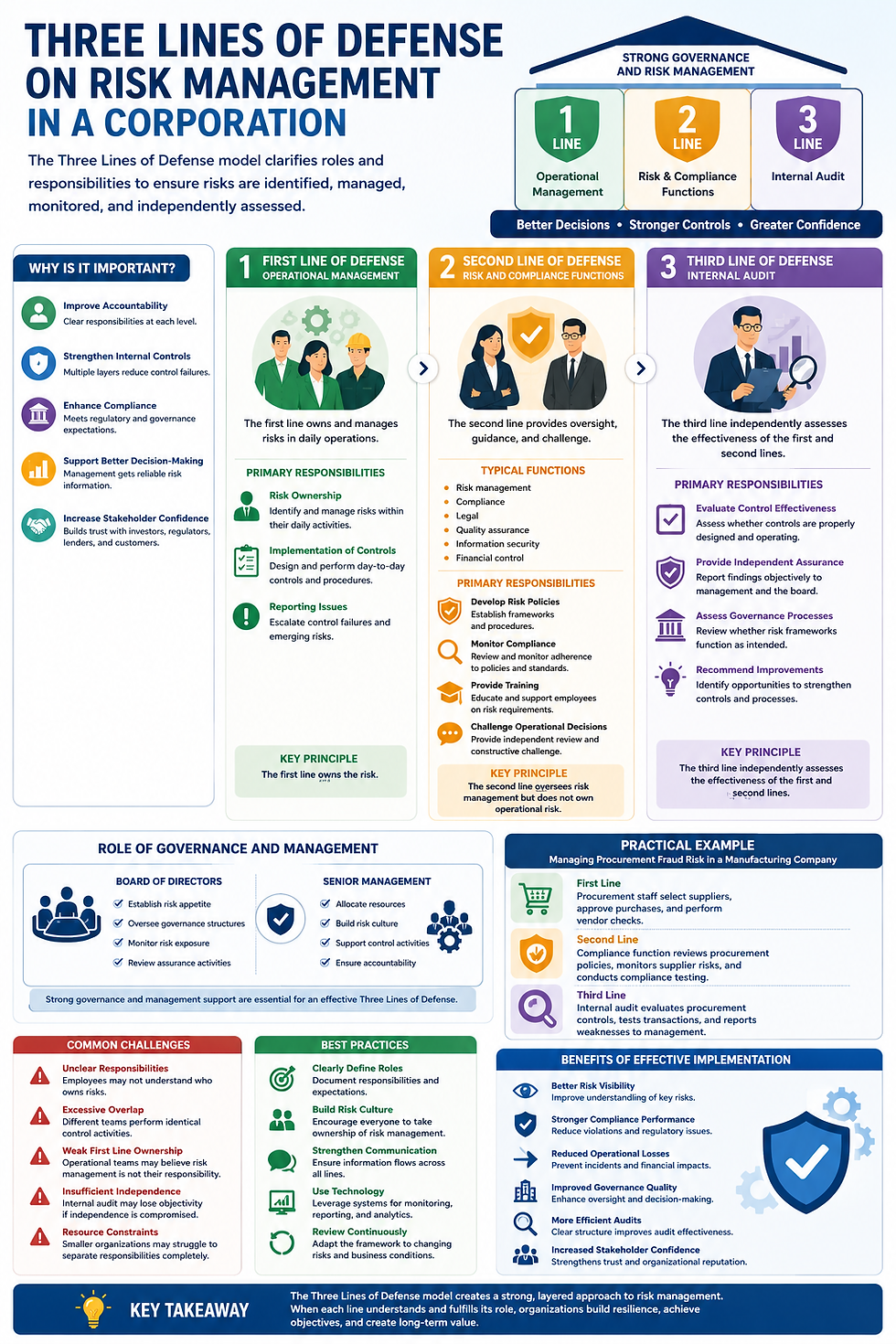
One of the most widely adopted frameworks for managing corporate risk is the Three Lines of Defense Model. This model establishes clear responsibilities across different functions within an organization to ensure risks are identified, managed, monitored, and independently assessed.
This article explains the Three Lines of Defense model, its components, responsibilities, benefits, and practical implementation.
What is the Three Lines of Defense Model?
The Three Lines of Defense model is a governance framework that defines how organizations assign responsibilities for risk ownership, risk oversight, and independent assurance.
The objective of the model is simple:
Ensure risks are managed effectively without creating gaps or overlaps in responsibilities.
The model separates risk responsibilities into three distinct layers:
First Line: Operational Management
Second Line: Risk Oversight Functions
Third Line: Independent Assurance
Together, these layers create a structured control environment that supports better decision-making and stronger governance.
Why is the Three Lines of Defense Important?
Organizations implement the model because it helps:
Improve Accountability
Each function clearly understands its risk responsibilities.
Strengthen Internal Controls
Multiple layers reduce the probability of control failures.
Enhance Regulatory Compliance
Many regulators and governance frameworks expect organizations to implement structured risk management systems.
Support Better Decision-Making
Management gains more reliable information about risks affecting operations.
Increase Stakeholder Confidence
Investors, regulators, lenders, and customers generally expect stronger governance practices.
First Line of Defense: Operational Management
The first line of defense consists of employees and managers who own and manage risks directly.
These are the individuals performing daily business activities.
Primary Responsibilities
Risk Ownership
Operational teams identify and manage risks within their activities.
Examples:
Sales teams managing customer risks
Procurement teams managing supplier risks
Finance teams managing payment risks
Production teams managing operational risks
Implementation of Controls
The first line designs and performs day-to-day controls.
Examples include:
Approval procedures
Segregation of duties
Reconciliations
Physical safeguards
Access controls
Reporting Issues
Operational teams should escalate control failures and emerging risks.
Key Principle
The first line owns the risk.
Without effective first-line ownership, risk management becomes reactive rather than preventive.
Second Line of Defense: Risk and Compliance Functions
The second line provides oversight and guidance.
Unlike operational teams, the second line typically does not own operational risks.
Instead, it monitors whether risks are properly managed.
Typical Second Line Functions
Examples include:
Risk management teams
Compliance departments
Legal departments
Quality assurance teams
Information security functions
Financial control functions
Primary Responsibilities
Develop Risk Policies
Establish frameworks and procedures.
Monitor Compliance
Review whether business units follow policies.
Provide Training
Help employees understand risk requirements.
Challenge Operational Decisions
Provide independent review and constructive challenge.
Key Principle
The second line oversees risk management but does not own operational risk.
Third Line of Defense: Internal Audit
The third line provides independent assurance.
Internal audit evaluates whether governance, risk management, and controls are functioning effectively.
Responsibilities of Internal Audit
Evaluate Control Effectiveness
Assess whether controls are properly designed and operating.
Provide Independent Assurance
Report findings objectively to senior management and governing bodies.
Assess Governance Processes
Review whether risk frameworks function as intended.
Recommend Improvements
Identify opportunities to strengthen control environments.
Why Independence Matters
Internal audit should remain sufficiently independent from operational management to provide objective assessments.
Key Principle
The third line independently assesses the effectiveness of the first and second lines.
Role of the Board and Senior Management
Although not formally considered one of the three lines, governance bodies play a critical role.
Board Responsibilities
Establish risk appetite
Oversee governance structures
Monitor risk exposure
Review assurance activities
Senior Management Responsibilities
Allocate resources
Build risk culture
Support control activities
Ensure accountability
Without strong governance support, the model may exist only on paper.
Practical Example of Three Lines of Defense
Consider a manufacturing company facing procurement fraud risk.
First Line
Procurement staff:
Select suppliers
Approve purchases
Perform vendor checks
Second Line
Compliance function:
Reviews procurement policies
Monitors supplier risks
Conducts compliance testing
Third Line
Internal audit:
Evaluates procurement controls
Tests transactions
Reports weaknesses to management
This layered approach reduces the likelihood that fraud risks remain undetected.
Common Challenges When Implementing the Model
Organizations frequently encounter several problems.
Unclear Responsibilities
Employees may not understand who owns risks.
Excessive Overlap
Different teams may perform identical control activities.
Weak First Line Ownership
Operational teams sometimes incorrectly believe risk management belongs only to compliance teams.
Insufficient Independence
Internal audit may lose effectiveness if independence is compromised.
Resource Constraints
Smaller organizations may struggle to separate responsibilities completely.
Best Practices for Effective Implementation
Clearly Define Roles
Document responsibilities explicitly.
Build Risk Culture
Encourage employees to view risk management as part of daily work.
Strengthen Communication
Ensure information flows between all lines.
Use Technology
Risk management systems improve monitoring and reporting.
Review Continuously
Risk frameworks should evolve with changing business conditions.
Benefits of Strong Three Lines of Defense Implementation
Organizations that implement the framework effectively often experience:
Better risk visibility
Stronger compliance performance
Reduced operational losses
Improved governance quality
More efficient audits
Increased stakeholder confidence
Risk management becomes embedded within operations rather than existing as a separate function.
Conclusion
The Three Lines of Defense model provides organizations with a structured approach to managing risk and strengthening governance.
By clearly separating risk ownership, oversight responsibilities, and independent assurance, companies can create stronger control environments and improve resilience against uncertainty.
Successful implementation requires more than simply creating departments—it requires accountability, communication, and a culture where risk management becomes everyone’s responsibility.
Source: Internet


Comments