Understand the Role of Investment Banks in an IPO


Introduction
When a company announces that it is "going public," headlines often focus on the company's founders, investors, or the stock exchange where the shares will be listed. However, behind every successful Initial Public Offering (IPO) is an investment bank working behind the scenes.
Investment banks are the architects, advisors, marketers, financial analysts, negotiators, and risk managers that guide companies through one of the most important milestones in their corporate journey. Without them, launching an IPO would be significantly more difficult, risky, and expensive.
This article explores the complete role of investment banks in an IPO—from the earliest planning stages to post-listing stabilization—and explains why they are indispensable partners in the public offering process.
What Is an Investment Bank?
An investment bank is a financial institution that helps corporations, governments, and other organizations raise capital, execute mergers and acquisitions (M&A), restructure businesses, and provide financial advisory services.
Unlike commercial banks that accept deposits and make loans to individuals, investment banks primarily work with businesses and institutional investors.
Some of the world's largest investment banks include:
Goldman Sachs
Morgan Stanley
JPMorgan
Bank of America Securities
Citigroup
Barclays
UBS
Deutsche Bank
Jefferies
Evercore (advisory)
Why Does a Company Need an Investment Bank?
Going public is much more than selling shares.
An IPO involves:
Regulatory compliance
Financial reporting
Company valuation
Investor marketing
Share pricing
Legal documentation
Institutional investor relationships
Stock market expertise
Most companies simply do not possess these capabilities internally.
Investment banks provide specialized expertise accumulated through hundreds of IPO transactions.
The Investment Bank's Responsibilities Throughout an IPO
The IPO process can be divided into several phases.
IPO Planning
↓
Company Due Diligence
↓
Valuation
↓
IPO Structure
↓
Prospectus Preparation
↓
Regulatory Approval
↓
Roadshow
↓
Book Building
↓
Pricing
↓
Listing
↓
Post-IPO Stabilization
Let's examine each stage.
Phase 1: IPO Readiness Assessment
Before agreeing to underwrite an IPO, the investment bank evaluates whether the company is actually ready.
Areas reviewed include:
Financial Performance
Revenue growth
Profitability
Cash flow
Debt level
Working capital
Business Model
Competitive advantage
Market size
Scalability
Industry outlook
Corporate Governance
Investment banks review:
Board independence
Audit committee
Internal controls
Risk management
Executive leadership
Financial Reporting
The company must usually have:
Audited financial statements
IFRS or US GAAP compliance
Strong accounting systems
Reliable financial controls
Phase 2: Advising on IPO Strategy
The investment bank helps answer major strategic questions.
Examples include:
Should the company go public now?
Timing depends on:
Market conditions
Industry performance
Interest rates
Investor sentiment
Competitor valuations
Sometimes delaying six months can significantly improve valuation.
Which Stock Exchange?
Possible choices:
NYSE
NASDAQ
London Stock Exchange
Hong Kong Stock Exchange
Singapore Exchange
Each market offers different:
Investor bases
Listing requirements
Liquidity
Valuation multiples
Primary vs Secondary Shares
Investment banks advise how many shares should be:
Primary shares:
Newly issued
Company receives cash
Secondary shares:
Existing shareholders sell
Company receives no proceeds
Phase 3: Company Valuation
One of the investment bank's most important responsibilities is determining what the company is worth.
Several valuation methods are used simultaneously.
Discounted Cash Flow (DCF)
Projects future cash flows.
Discounts them back to present value.
Useful for mature businesses.
Comparable Company Analysis
Compare valuation multiples such as:
P/E
EV/EBITDA
EV/Sales
Against similar public companies.
Precedent Transactions
Analyzes recent acquisitions of similar companies.
Shows what strategic buyers have paid.
Market Demand
Sometimes valuation depends less on financial models and more on investor appetite.
Example:
Two identical companies may receive very different valuations depending on market sentiment.
Phase 4: Underwriting the IPO
This is where investment banks earn much of their reputation.
What Is Underwriting?
Underwriting means the investment bank agrees to sell the company's shares to investors.
Depending on the agreement, they may even purchase the shares first.
Firm Commitment
Most common for large IPOs.
Investment bank purchases all shares.
Company
↓
Investment Bank
↓
Public Investors
Risk:
If investors don't buy all shares...
The investment bank owns the remaining shares.
Best Efforts
Investment bank only agrees to use its best efforts to sell shares.
Unsold shares remain with the company.
Lower risk for the bank.
Higher risk for the issuer.
Phase 5: Due Diligence
Investment banks perform extensive due diligence.
Purpose:
Verify that every material statement in the prospectus is accurate.
They review:
Financial statements
Contracts
Customers
Suppliers
Litigation
Intellectual property
Tax compliance
Employment agreements
Regulatory issues
Environmental risks
This protects both investors and the bank.
Phase 6: Preparing the Prospectus
The prospectus is the official IPO document.
Investment banks work closely with:
Lawyers
Auditors
Company management
The prospectus contains:
Company overview
Industry analysis
Risk factors
Historical financial statements
Management discussion
Future strategy
Share offering details
Use of IPO proceeds
Phase 7: Regulatory Coordination
Investment banks coordinate submissions with regulators.
Activities include:
Filing registration statements
Responding to regulator comments
Revising disclosures
Coordinating legal advisors
Managing listing requirements
Phase 8: Marketing the IPO (Roadshow)
This is one of the most visible stages.
Senior executives travel to meet institutional investors.
Typical investors include:
Mutual funds
Pension funds
Sovereign wealth funds
Insurance companies
Hedge funds
The investment bank organizes:
Meeting schedules
Investor presentations
Q&A sessions
Financial models
Market feedback
Phase 9: Book Building
During the roadshow, investors indicate:
How many shares they want
At what price
Example
Investor | Shares Requested | Price |
Fund A | 5 million | $24 |
Fund B | 10 million | $25 |
Fund C | 3 million | $26 |
The investment bank builds an "order book."
This information determines:
Demand
Optimal price
Share allocation
Phase 10: IPO Pricing
Pricing is a balancing act.
Too high:
❌ Investors may not buy.
Too low:
❌ Company leaves money on the table.
Investment banks analyze:
Market demand
Comparable companies
Economic conditions
Investor feedback
Subscription levels
Phase 11: Share Allocation
Not every investor receives all requested shares.
Investment banks prioritize:
Long-term investors
High-quality institutions
Strategic shareholders
Geographic diversification
This helps create a stable shareholder base.
Phase 12: Stock Exchange Listing
Once pricing is finalized:
Shares are issued
Trading begins
Investors buy and sell freely
The investment bank coordinates with:
Stock exchange
Depositories
Brokers
Clearing systems
Phase 13: Price Stabilization
Immediately after listing, share prices can become volatile.
Investment banks often act as stabilization managers.
Greenshoe Option
One common stabilization mechanism is the Greenshoe Option.
Example:
IPO:
100 million shares
Bank receives option to sell:
15 million additional shares
If demand is very high:
Bank exercises the option.
If price falls:
Bank purchases shares in the market to support the price.
Phase 14: Equity Research Coverage
After the quiet period expires, analysts from the investment bank often begin publishing:
Research reports
Earnings forecasts
Industry analysis
Buy/Hold/Sell recommendations
This improves market visibility and supports investor engagement.
Phase 15: Future Capital Raising
The IPO is often just the beginning.
Investment banks continue advising companies on:
Secondary offerings
Convertible bonds
Corporate bonds
Mergers & acquisitions
Share buybacks
Private placements
Long-term relationships are common.
Revenue Sources for Investment Banks
Investment banks earn income from several IPO-related services.
Service | Revenue Source |
Underwriting | Underwriting fee |
Financial Advisory | Advisory fee |
Valuation | Consulting fee |
Book Building | Underwriting spread |
Roadshow Management | Included in underwriting |
Due Diligence | Advisory fee |
Stabilization | Underwriting spread |
Research Coverage | Strategic client relationship |
How Much Do Investment Banks Charge?
IPO underwriting fees vary by market, company size, and complexity.
Typical ranges include:
IPO Size | Typical Fee |
Small IPO | 5–8% |
Medium IPO | 4–6% |
Large IPO | 2–5% |
Mega IPO | Less than 2% |
For a US$1 billion IPO with a 5% underwriting fee, total fees could reach approximately US$50 million, shared among the lead underwriters and syndicate members.
Risks Faced by Investment Banks
Investment banks also assume significant risks.
Underwriting Risk
If demand is weak, banks may be left holding unsold shares.
Legal Risk
Inaccurate disclosures can lead to lawsuits and regulatory penalties.
Reputation Risk
A poorly performing IPO can damage the bank's standing and reduce future mandates.
Market Risk
Volatile markets may force the bank to postpone or reprice an offering.
Real-World Example of an IPO Syndicate
Large IPOs are often managed by a syndicate rather than a single bank.
A typical structure includes:
Lead Left Bookrunner – Coordinates the entire IPO process, manages pricing, and oversees the order book.
Joint Bookrunners – Share responsibility for marketing, book building, and investor outreach.
Co-Managers – Support distribution of shares and broaden access to investors.
Selling Group Members – Help distribute shares without taking on underwriting risk.
This collaborative approach allows the underwriting risk to be shared across multiple institutions while leveraging broader investor networks.
Key Skills Investment Bankers Bring to an IPO
Successful IPO execution requires a combination of technical expertise and market insight.
Core competencies include:
Financial modeling
Business valuation
Capital markets knowledge
Regulatory compliance
Investor relations
Negotiation
Project management
Risk assessment
Marketing to institutional investors
Transaction execution
The IPO Ecosystem
An IPO is a coordinated effort involving multiple stakeholders.
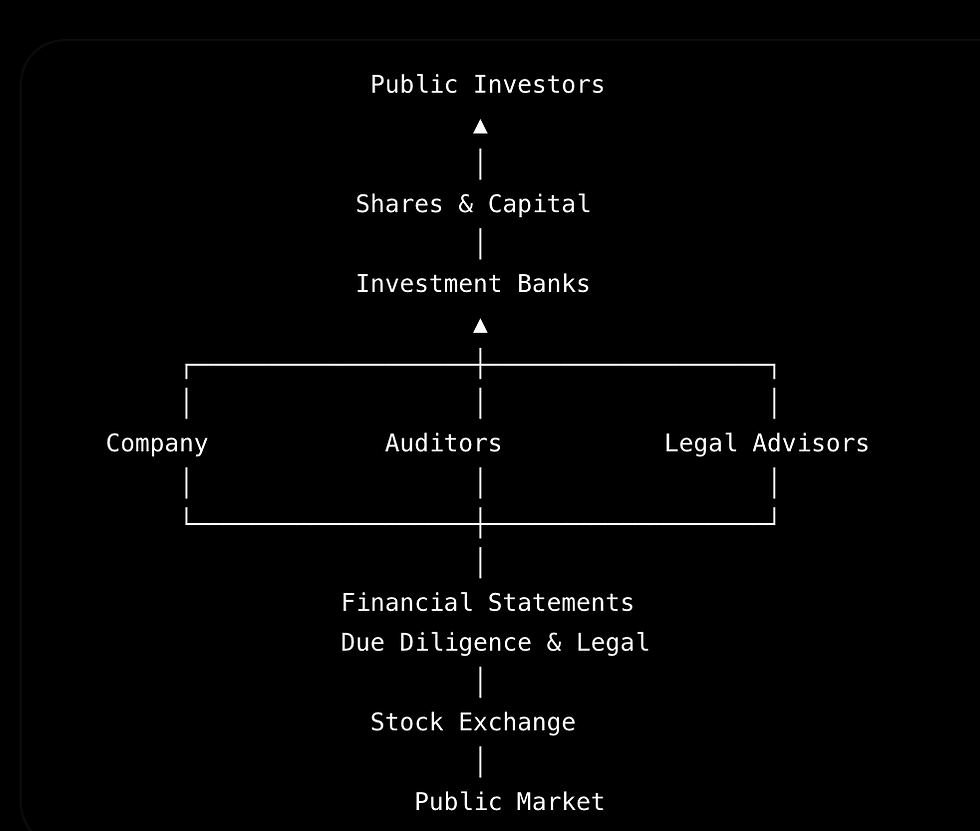
The investment bank serves as the central coordinator, connecting the company with auditors, legal advisors, regulators, institutional investors, and the stock exchange.
Conclusion
Investment banks are far more than intermediaries that sell shares. They are strategic advisors who guide companies through every stage of the IPO lifecycle—from assessing readiness and determining valuation to marketing the offering, underwriting the shares, coordinating regulatory approvals, and supporting trading after the listing.
Their expertise helps companies maximize the capital raised, reach the right investors, comply with complex regulations, and establish a strong foundation as publicly traded businesses. For many organizations, the choice of investment bank is one of the most important decisions made during the IPO journey, influencing not only the success of the offering but also the company's long-term reputation in the capital markets.
Resources : Internet


Comments