A Comprehensive Comparison Among US, UK, Australian, Singapore Accounting and Taxes

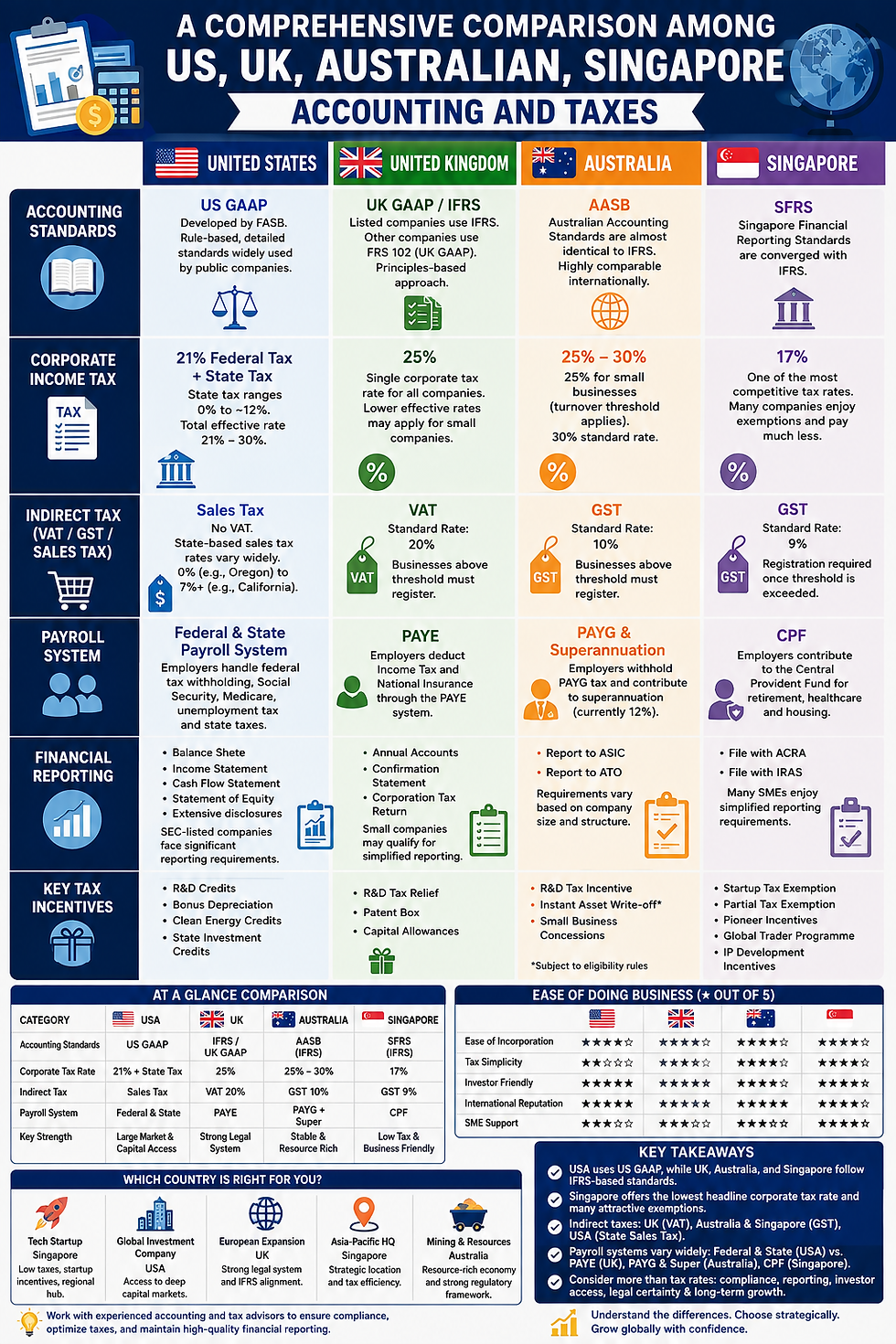
Published: 2026 Edition
Category: International Taxation | Accounting | Business | Finance
Introduction
Expanding a business internationally is no longer limited to multinational corporations. Thanks to globalization and digital commerce, startups, SMEs, and freelancers increasingly operate across multiple jurisdictions. However, every country has its own accounting standards, tax regulations, reporting requirements, and compliance obligations.
Four of the world's most attractive business destinations are:
🇺🇸 United States
🇬🇧 United Kingdom
🇦🇺 Australia
🇸🇬 Singapore
Although all four are developed economies with transparent legal systems, they differ significantly in accounting frameworks, corporate tax systems, payroll obligations, indirect taxes, filing deadlines, and incentives.
This guide compares these countries from an accounting and taxation perspective to help entrepreneurs, investors, accountants, and finance professionals understand the key differences.
Quick Comparison
Category | USA | UK | Australia | Singapore |
Accounting Standards | US GAAP / IFRS (limited) | UK GAAP / IFRS | Australian Accounting Standards (AASB/IFRS) | Singapore Financial Reporting Standards (SFRS/IFRS) |
Corporate Tax | Federal + State | Single Corporate Tax | Single Corporate Tax | Single Corporate Tax |
VAT/GST | Sales Tax | VAT | GST | GST |
Payroll Tax | Federal + State | PAYE | PAYG | CPF |
Fiscal Year | Flexible | Flexible | Flexible | Flexible |
Currency | USD | GBP | AUD | SGD |
1. Accounting Standards
United States
The United States primarily follows US Generally Accepted Accounting Principles (US GAAP).
US GAAP is developed by the Financial Accounting Standards Board (FASB).
Characteristics:
Highly detailed
Rule-based
Extensive industry-specific guidance
Widely accepted by investors
Public companies listed in the US generally use US GAAP.
United Kingdom
The UK uses:
UK GAAP (FRS 102)
IFRS for listed companies
Since IFRS is principles-based, businesses generally have greater flexibility than under US GAAP.
Small businesses often prepare financial statements under FRS 102 or FRS 105.
Australia
Australia adopts IFRS almost entirely through:
Australian Accounting Standards (AASB)
These standards are almost identical to IFRS with limited local modifications.
Australian financial statements are therefore highly comparable internationally.
Singapore
Singapore adopts:
Singapore Financial Reporting Standards (SFRS)
These are substantially converged with IFRS.
Large corporations and listed entities generally use SFRS (International).
Comparison
Country | Standard | IFRS Compatible |
USA | US GAAP | Limited |
UK | IFRS / UK GAAP | Yes |
Australia | AASB | Yes |
Singapore | SFRS | Yes |
2. Corporate Income Tax
United States
The US has one of the most complex tax systems.
Businesses may pay:
Federal Corporate Tax
State Corporate Tax
Local Business Taxes
Federal corporate income tax:
21%
State taxes vary from:
0% to approximately 12%
Total effective tax often ranges:
21%–30%
United Kingdom
Corporate tax is simpler.
Current main rate:
25%
Smaller companies may qualify for lower effective rates through marginal relief.
Australia
Corporate tax depends on business size.
Standard company tax:
30%
Small base rate entities:
25%
Singapore
Singapore has one of the world's most competitive tax systems.
Headline rate:
17%
However, various exemptions mean many SMEs pay much less.
Some startups pay little or no corporate tax during their early years.
Corporate Tax Comparison
Country | Main Rate |
Singapore | 17% |
USA | 21% Federal + State |
UK | 25% |
Australia | 25–30% |
3. Indirect Taxes (VAT / GST / Sales Tax)
USA
The United States does not have VAT.
Instead, it has:
Sales Tax
Collected by states.
Rates vary significantly.
Examples:
Oregon: 0%
California: approximately 7.25%+
New York: varies
Sales tax complexity is one of the largest compliance challenges.
United Kingdom
Uses:
Value Added Tax (VAT)
Standard rate:
20%
Businesses exceeding the registration threshold generally must register.
Australia
Uses:
Goods and Services Tax (GST)
Standard rate:
10%
Businesses with sufficient turnover generally must register.
Singapore
Uses:
Goods and Services Tax (GST)
Current rate:
9%
GST registration is required once businesses exceed the prescribed threshold or in other applicable circumstances.
VAT/GST Comparison
Country | Tax Type | Standard Rate |
USA | Sales Tax | State dependent |
UK | VAT | 20% |
Australia | GST | 10% |
Singapore | GST | 9% |
4. Payroll Systems
USA
Payroll is highly decentralized.
Employers may need to handle:
Federal Income Tax Withholding
Social Security
Medicare
Federal Unemployment Tax
State Taxes
Many businesses outsource payroll.
UK
Uses:
PAYE (Pay As You Earn)
Employers deduct:
Income Tax
National Insurance
Everything is reported electronically.
Australia
Employers use:
PAYG Withholding
They also contribute:
Superannuation
Currently:
12% employer contribution (subject to applicable rules and timing).
Singapore
Payroll is relatively straightforward.
Employers contribute to:
Central Provident Fund (CPF)
CPF funds:
Retirement
Healthcare
Housing
Contribution rates vary depending on age, salary, residency status, and other factors.
Payroll Comparison
Country | Main System |
USA | Federal & State Payroll |
UK | PAYE |
Australia | PAYG + Superannuation |
Singapore | CPF |
5. Financial Reporting Requirements
USA
Typical reports include:
Balance Sheet
Income Statement
Cash Flow Statement
Statement of Equity
Extensive disclosures
SEC-listed companies face significant reporting requirements.
UK
Companies file:
Annual Accounts
Confirmation Statement
Corporation Tax Return
Small companies may qualify for simplified reporting.
Australia
Companies report to:
Australian Securities & Investments Commission (ASIC)
Australian Taxation Office (ATO)
Requirements vary depending on company size and structure.
Singapore
Companies generally file with:
Accounting and Corporate Regulatory Authority (ACRA)
Inland Revenue Authority of Singapore (IRAS)
Many SMEs enjoy simplified reporting.
6. Tax Incentives
USA
Popular incentives include:
R&D Credits
Bonus Depreciation
Clean Energy Credits
State Investment Credits
UK
Examples include:
R&D Tax Relief
Patent Box
Capital Allowances
Australia
Major incentives include:
R&D Tax Incentive
Instant Asset Write-off (subject to current eligibility rules)
Small Business Concessions
Singapore
Singapore is well known for:
Startup Tax Exemption
Partial Tax Exemption
Pioneer Incentives
Global Trader Programme
IP Development Incentives
7. Ease of Doing Business
Criteria | USA | UK | Australia | Singapore |
Ease of Incorporation | ★★★★☆ | ★★★★★ | ★★★★☆ | ★★★★★ |
Tax Simplicity | ★★☆☆☆ | ★★★★☆ | ★★★★☆ | ★★★★★ |
Investor Friendly | ★★★★★ | ★★★★★ | ★★★★☆ | ★★★★★ |
International Reputation | ★★★★★ | ★★★★★ | ★★★★★ | ★★★★★ |
SME Support | ★★★☆☆ | ★★★★☆ | ★★★★☆ | ★★★★★ |
Advantages and Challenges
🇺🇸 United States
Advantages
Largest capital market
Strong investor confidence
Mature financial ecosystem
Significant tax credits
Challenges
Complex multi-level taxation
State-by-state compliance
Higher accounting costs
🇬🇧 United Kingdom
Advantages
IFRS-based reporting
Straightforward tax administration
Strong legal framework
Challenges
Higher corporate tax than Singapore
VAT compliance requirements
🇦🇺 Australia
Advantages
Stable regulatory environment
Transparent accounting standards
Strong SME support
Challenges
Higher labor costs
Superannuation obligations
Corporate tax may reach 30%
🇸🇬 Singapore
Advantages
Low corporate tax
Simple tax administration
Extensive treaty network
Business-friendly government
Strong regional hub for Asia-Pacific
Challenges
Smaller domestic market
Rising operating costs
Tight labor policies for certain foreign workers
Which Country Is Best for Your Business?
Business Type | Recommended Country | Why |
Technology Startup | Singapore | Low taxes, startup incentives, regional hub |
Global Investment Company | USA | Access to deep capital markets |
European Expansion | UK | Strong legal system and IFRS alignment |
Asia-Pacific Headquarters | Singapore | Strategic location and tax efficiency |
Mining & Natural Resources | Australia | Resource-rich economy and established regulatory framework |
Manufacturing with US Customers | USA | Large domestic market and customer proximity |
International Consulting Firm | Singapore or UK | Competitive tax regimes and strong professional services sectors |
Key Takeaways
Accounting Standards: The USA primarily uses US GAAP, while the UK, Australia, and Singapore are closely aligned with IFRS.
Corporate Tax: Singapore generally offers the lowest headline corporate tax rate and a range of attractive exemptions. The USA combines federal and state taxes, often leading to a higher overall burden.
Indirect Tax: The UK uses VAT, Australia and Singapore use GST, and the USA relies on state-level sales taxes.
Payroll: The USA has the most decentralized payroll system, while the UK (PAYE), Australia (PAYG and Superannuation), and Singapore (CPF) have more centralized frameworks.
Business Environment: Singapore stands out for tax simplicity and ease of doing business, the USA offers unparalleled access to capital and market size, the UK provides a well-established legal and financial ecosystem, and Australia combines regulatory stability with strong support for businesses operating in the Asia-Pacific region.
Final Thoughts
Choosing where to establish or expand your business involves more than comparing tax rates. Accounting standards, compliance requirements, payroll obligations, reporting complexity, access to investors, legal certainty, and long-term growth opportunities all play a critical role.
For multinational businesses, understanding the differences between the United States, United Kingdom, Australia, and Singapore can help reduce compliance risks, improve tax efficiency, and support informed strategic decisions. Many organizations also benefit from working with experienced accounting and tax advisors to navigate local regulations while maintaining consistent global financial reporting and governance.
Resources : Internet


Comments