Risk Identification and Risk Management in the Banking Sector

Introduction
Banks are the backbone of every modern economy. They facilitate payments, provide loans, safeguard deposits, support businesses, and enable international trade. However, because banks deal primarily with other people’s money and operate with high leverage, they face numerous risks every day.
History has shown that poor risk management can cause catastrophic consequences. The 2008 Global Financial Crisis, the collapse of Silicon Valley Bank (2023), and numerous banking failures around the world demonstrate how quickly unmanaged risks can spread through an entire financial system.
This is why modern banking places risk management at the center of every strategic and operational decision.
This article explores the entire risk management framework in banking—from identifying risks to measuring, controlling, monitoring, and reporting them.
Why Risk Management Matters
Banks accept deposits while lending money to borrowers.
This simple business model exposes banks to numerous uncertainties:
Borrowers may default.
Interest rates may change.
Foreign exchange rates may fluctuate.
Customers may withdraw deposits suddenly.
Cyber criminals may attack systems.
Regulations may change.
Economic recessions may increase loan losses.
Without effective risk management:
Capital can be wiped out.
Liquidity can disappear.
Customer confidence can collapse.
Regulators may intervene.
Banks may fail.
Therefore, risk management is not merely a compliance function—it is fundamental to a bank’s survival.
Enterprise Risk Management Framework
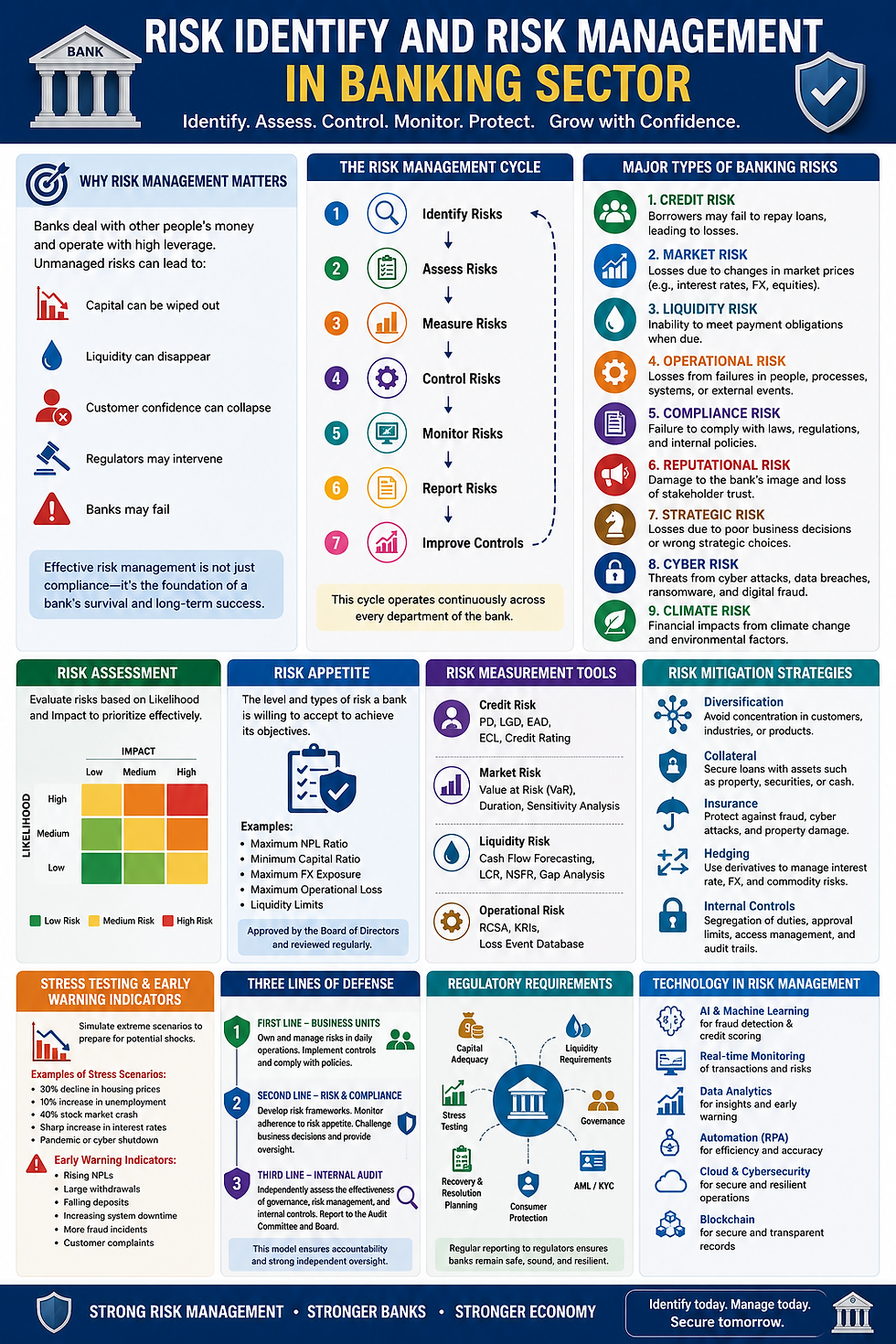
A modern bank typically follows a continuous risk management cycle.
Identify Risks
        ↓
Assess Risks
        ↓
Measure Risks
        ↓
Control Risks
        ↓
Monitor Risks
        ↓
Report Risks
        ↓
Improve Controls
        ↓
Repeat
This cycle operates continuously across every department.
Step 1: Risk Identification
Risk identification is the process of recognizing every event that could negatively affect the bank.
Banks perform risk identification through:
Business process reviews
Internal audits
External audits
Regulatory inspections
Risk workshops
Scenario analysis
Historical loss analysis
Incident reporting
Stress testing
Data analytics
Every department contributes to identifying risks.
For example:
DepartmentExample RisksLendingLoan defaultsTreasuryInterest rate changesITCyber attacksOperationsProcessing errorsHREmployee fraudComplianceRegulatory violationsLegalLawsuitsFinanceFinancial reporting errors
Major Types of Banking Risks
1. Credit Risk
Credit risk is the possibility that borrowers fail to repay loans.
This is usually the largest risk for commercial banks.
Examples include:
Mortgage defaults
Corporate bankruptcy
Credit card losses
SME loan failures
Counterparty default
Common Indicators
Non-performing loan (NPL) ratio
Probability of Default (PD)
Loss Given Default (LGD)
Exposure at Default (EAD)
Expected Credit Loss (ECL)
Controls
Credit scoring
Collateral
Loan approval hierarchy
Credit limits
Portfolio diversification
Continuous monitoring
2. Market Risk
Market risk arises from movements in financial market prices.
Examples include:
Interest rates
Foreign exchange
Equity prices
Commodity prices
Bond prices
Typical Banking Exposure
Treasury departments hold:
Government bonds
Foreign currencies
Derivatives
Equities
Price fluctuations may generate significant losses.
Measurement
Value at Risk (VaR)
Sensitivity Analysis
Duration
Stress Testing
3. Liquidity Risk
Liquidity risk occurs when banks cannot meet payment obligations.
Example:
Customers suddenly withdraw billions of dollars.
If the bank cannot provide cash quickly, it may fail despite owning valuable long-term assets.
Liquidity Indicators
Liquidity Coverage Ratio (LCR)
Net Stable Funding Ratio (NSFR)
Cash ratio
Funding concentration
Controls
Maintain liquid assets
Diversify funding
Contingency funding plans
Central bank facilities
4. Operational Risk
Operational risk results from failures in people, processes, systems, or external events.
Examples:
Human error
Fraud
System failure
Cyber attack
Data loss
Natural disasters
Operational risk exists in every banking activity.
Controls
Segregation of duties
Dual authorization
Internal controls
IT security
Disaster recovery
Business continuity planning
5. Compliance Risk
Banks operate in one of the world’s most regulated industries.
Examples:
Anti-Money Laundering (AML)
Know Your Customer (KYC)
Capital adequacy
Consumer protection
Data privacy
Sanctions compliance
Failure can lead to:
Massive fines
License suspension
Criminal prosecution
Reputation damage
6. Reputational Risk
Reputation is one of a bank’s most valuable assets.
Damage may result from:
Fraud
Money laundering
Cyber breaches
Customer complaints
Executive misconduct
Social media incidents
Loss of trust often triggers customer withdrawals.
7. Strategic Risk
Strategic risk comes from poor business decisions.
Examples:
Entering risky markets
Acquiring poor-quality assets
Aggressive lending
Poor technology investment
Weak corporate governance
8. Cyber Risk
Digital banking has made cybersecurity one of the fastest-growing risks.
Threats include:
Ransomware
Phishing
Identity theft
Data breaches
Insider attacks
ATM malware
Modern banks invest billions annually in cybersecurity.
9. Climate Risk
Climate change increasingly affects financial institutions.
Examples:
Flood damage to collateral
Agricultural loan defaults
Carbon transition risks
Insurance losses
Many regulators now require climate stress testing.
Risk Assessment
Once identified, risks are evaluated based on two dimensions:
Likelihood
Impact
Example:
RiskLikelihoodImpactRatingCyber AttackHighHighCriticalEmployee FraudMediumHighHighEarthquakeLowHighMediumPrinter FailureHighLowLow
Banks usually prioritize critical risks.
Risk Appetite
Every bank defines how much risk it is willing to accept.
This is called the Risk Appetite Statement (RAS).
Examples include:
Maximum NPL ratio
Minimum capital ratio
Maximum foreign exchange exposure
Maximum operational loss
Liquidity limits
The Board of Directors approves these limits.
Risk Measurement Tools
Banks use quantitative models to estimate risk exposure.
Common tools include:
Credit Risk
Credit Score
PD
LGD
ECL
Credit Rating
Market Risk
Value at Risk (VaR)
Duration
Gap Analysis
Sensitivity Analysis
Liquidity Risk
Cash Flow Forecasting
Liquidity Gap Analysis
LCR
NSFR
Operational Risk
Risk Control Self Assessment (RCSA)
Key Risk Indicators (KRIs)
Loss Event Database
Risk Mitigation Strategies
Banks cannot eliminate risk, but they can reduce it.
Methods include:
Diversification
Avoid concentrating loans in:
One customer
One industry
One country
One product
Collateral
Require assets such as:
Property
Equipment
Cash deposits
Securities
Insurance
Cover:
Fraud
Cyber attacks
Property damage
Professional liability
Hedging
Use derivatives such as:
Swaps
Futures
Options
Forward contracts
Internal Controls
Examples include:
Segregation of duties
Approval limits
Automated controls
Access management
Audit trails
Stress Testing
Banks regularly simulate extreme scenarios.
Examples:
30% housing price decline
10% unemployment
40% stock market crash
Large interest rate increase
Pandemic
Cyber shutdown
Stress testing helps management prepare contingency plans.
Early Warning Indicators
Banks monitor indicators that signal increasing risk.
Examples:
Credit Risk
Late payments
Credit score deterioration
Industry downturn
Liquidity Risk
Large withdrawals
Falling deposits
Rising funding costs
Operational Risk
Increasing system downtime
Fraud incidents
Customer complaints
The Three Lines of Defense
A strong governance model separates risk ownership from oversight.
First Line – Business Units
Own and manage risks in daily operations.
Implement controls and comply with policies.
Second Line – Risk Management & Compliance
Develop risk frameworks.
Monitor adherence to risk appetite.
Challenge business decisions and provide oversight.
Third Line – Internal Audit
Independently assess the effectiveness of governance, risk management, and internal controls.
Report findings directly to the Audit Committee and Board.
This model strengthens accountability and promotes independent assurance across the organization.
Regulatory Requirements
Banks operate under strict regulatory standards.
Key areas include:
Capital adequacy
Liquidity requirements
Stress testing
Governance
Recovery and resolution planning
AML/KYC
Consumer protection
Operational resilience
Regular reporting to regulators ensures banks remain financially sound and resilient.
Technology and Modern Risk Management
Banks increasingly rely on technology to strengthen risk management.
Key technologies include:
Artificial Intelligence for fraud detection
Machine learning for credit scoring
Real-time transaction monitoring
Robotic Process Automation (RPA)
Big data analytics
Cloud computing
Blockchain for secure transaction records
Predictive analytics for early warning systems
These technologies enhance both efficiency and the ability to detect emerging risks.
Best Practices for Effective Banking Risk Management
Successful banks typically:
Foster a strong risk-aware culture.
Clearly define risk appetite and tolerance.
Maintain robust governance and independent oversight.
Continuously monitor key risk indicators.
Invest in cybersecurity and operational resilience.
Diversify portfolios and funding sources.
Conduct regular stress tests and scenario analyses.
Ensure compliance with evolving regulations.
Leverage data analytics and automation.
Continuously improve controls based on lessons learned.
Conclusion
Risk is inherent to banking, but unmanaged risk can threaten the stability of individual institutions and the wider financial system. Effective risk management requires more than sophisticated models—it demands a disciplined culture, strong governance, reliable data, and continuous monitoring.
By systematically identifying, assessing, measuring, controlling, and reporting risks, banks can safeguard customer deposits, maintain regulatory compliance, support sustainable growth, and strengthen public confidence. In an environment shaped by digital transformation, geopolitical uncertainty, climate change, and evolving regulations, robust risk management remains one of the most critical capabilities for every financial institution.
Resources : Internet


Comments